
A sample of my astro photos with descriptions (click to expand)
The Pleiades (M 45)
October 2024

Williams Optical Zenithstar 73 with field flattener, ASI 2600MC, Altair Quadband filter, 29 x 300 sec (total integration ~2.5 hours)
Oct 2024, Doylestown, PA
Copyright 2024 Paul C. Kolosick
All Rights Reserved
Comet C/2023 A3 (Tsuchinshan-ATLAS)
October 2024

Just a few days later, the ATLAS (Asteroid Terrestrial-impact Last Alert System) survey in Hawaii also spotted the comet, giving it its dual name.
Williams Optica Zenithstar 73 (with field flattener), ASI2600MC, no filter, AM5
20 x 20 sec exposures (total integration 6.7 min).
Oct 2024, Doylestown, PA
Copyright 2024 Paul C. Kolosick
All Rights Reserved
Whirlpool Galaxy (M 51)
March 2025

M51 is ~23 million light years (ly) away and is approximately 38,000 ly across. The smaller M51a/NGC5194 has interacted with the larger M51 as can be seen by the trailing spiral arm of M51. There are two distant galaxies visible to the right (IC 4263 and NGC 5169)
Williams Optical Zenithstar 73 with Field flattener, ASI 2600MC, Altair Quadband filter, AM5 120 x 300 sec (total integration time 10 hrs)
Doylestown, PA
Mar 2025
Copyright 2024 Paul C. Kolosick
All Rights Reserved
Horsehead Nebula
October 2024

Also contains Barnard 33- Horsehead Nebula (dark nebula in center) and NGC 2024 Flame Nebula (orange region at top left).
Williams Optical Zenithstar 73 with Field Flattener, ASI 2600MC, no filter, AM5.
60 x 300 sec (total integration 5 hours)
Oct 2024. Doylestown, PA
Processed in PixInsight
Copyright 2024 Paul C. Kolosick
All Rights Reserved
Orion Nebula (M42)
March 2025

M 42 is one of the brightest nebula. This star forming region can be seen in the middle of Orion’s “Sword”. It is the closest region of massive star formation to Earth. The UV radiation from these stars (~100,000 years old) causes the nebula to fluoresce.
This naked eye visible nebula is ~1400 light years away and ~35 light years across.
Williams Optical Zenithstar 73 with field flattener, ASI 2600MC, Altair Quad Filter, AM5
HDR Process of: 96 x 10 sec, 44 x 20 sec,
37 x 180 sec, 5 x 300 sec (total integration 2.75 hours)
Mar 2025, Doylestown, PA
Processed in PixInsight
Copyright 2025 Paul C. Kolosick
All Rights Reserved
Bailey’s Beads
April 2024

2024 Eclipse Totality, Third Contact (C3) with two Bailey’s Beads @ 4:00, clear prominences (@3:30, 4:00, 5:30 & 6:00 O’clock, 3:30 and 6:00 are especially vivid). Bailey’s Beads occur just after or just before the “Diamond Ring” effect during a total solar eclipse. The phenomenon results as the edge of the sun becomes only visible through valleys in the mountains on the rim of the moon. The number of beads is dependent on the actual alignment of the sun and moon and varies from eclipse to eclipse.
Nikon D7500 with Sigma 100-400mm Zoom Lens @ 400mm (35mm equivalent 600 mm). Tracking with Star Adventurer GTi. No filter during totality.
Apr 2024 Goldthwaite, TX
Processed in Photoshop
Copyright 2024 Paul C. Kolosick
All Rights Reserved
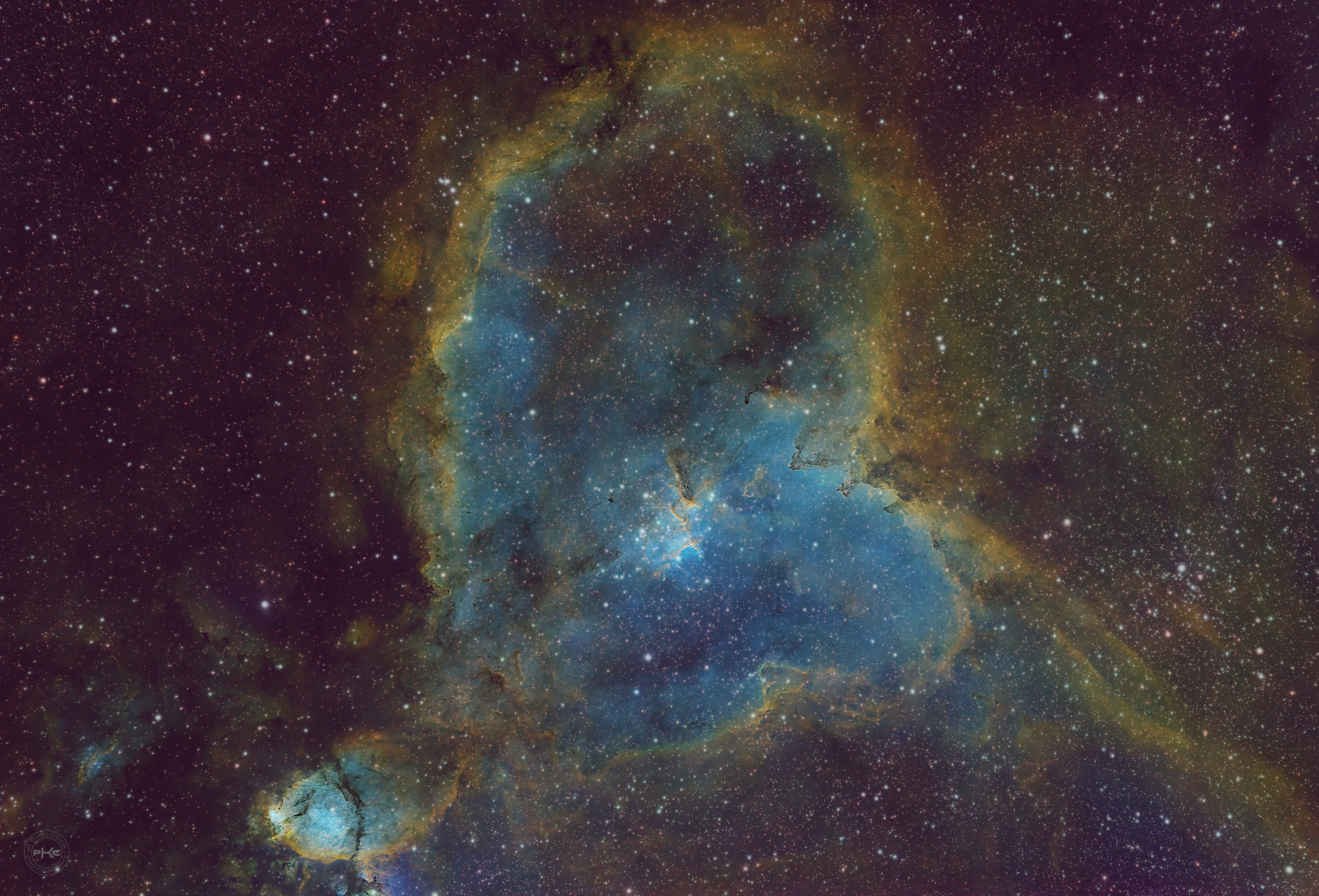
Heart Nebula (IC 1805)
September 2025

WO Zenithstar 73 with field flattener, ASI 2600 MC, AM5 with Altair Quad and Dual Band filters
40×300 secs with Altair Ha-Oiii 4 nm filter for nebulosity)
40×300 secs with Altair Oiii-Sii 4 nm filter (for nebulosity)
(nebulosity total integration ~7 hours)
30×300 secs with Altair Quad Band filter for star field
(star field integration ~2.5 hours)
Cherry Springs PA (Dual Band)
Doylestown, PA (Quad Band)
Processed in PixInsight using DBExtraxt to extract Ha, Oiii, and Sii signals
Copyright 2025 Paul C. Kolosick
All Rights Reserved
Lagoon Nebula (M 8/NGC 6523)
August 2024

The Lagoon Nebula is in the heart of the Sagittarius-Carina arm of the Milky way ~4300 light years (ly) away and ~100 x 60 ly across. This Nebula covers three times the area of the full moon in our sky (and is naked eye visible from suitably dark skies).
Williams Optical Zenithstar 73 mm scope with field flattener, Nikon D7500 ISO3200, 25 x 180 sec (total integration time ~1.25 hours)
August 2024 (near) Zion National Park, UT,
Processed in PixInsight
Copyright 2024 Paul C. Kolosick
All Rights Reserved
Check back occasionally for new pictures or information updates on the existing photos.
Clear Skies!
Paul