
These are the 13 pictures captured in 2025 that I chose in creating a 2026 Deep Sky Calendar for my friends and family. Below each picture is some information about the object(s), the equipment, and the capture method.

Cover Art
Cone Nebula and Christmas Tree Cluster (NGC 2264)
NGC 2264 includes both the Cone Nebula and the Christmas Tree Star Cluster. The star cluster is in the middle of a large diffuse nebulosity. The Cone Nebula lies at the south end of the nebulosity. The star cluster is ~ 20 light years across and the entire structure is ~ 2600 light years from Earth.
Williams Optical Zenithstar 73 with field flattener, ASI 2600 MC Air , Altair Quad band filter, AM5 30 x 300 sec (total integration 2.5 hrs).
Frame size (height x width) ~ 4 x 3 full moons
March, 2025, Doylestown, PA
Processed in PixInsight
Copyright 2025 Paul C. Kolosick, All Rights Reserved

January
Crescent Nebula NGC 6888 (C27) – HOO
NGC 6888 is an emission Nebula in Cygnus. The Nebula is ~4700 light years from Earth. The central star Wolf-Rayet HD 192163 (WR 136) became a red giant ~400,000 years ago.
The nebula is formed by the interaction of the fast moving stellar wind from the current red giant interacting with the slower moving stellar wind from the red giant formation. The collision of the two shells heats the stellar wind to X-ray emitting temperatures. The shell is ~ 25 light years across.
Williams Optical Zenithstar 73 with field flattener, ASI 2600 MC Air , Optolong Ultimate filter, AM5 240 x 300 secs (total integration 20 hrs).
Frame size (height x width) ~ 4 x 3 full moons
August 8-12, 2025, Doylestown, PA
Processed in PixInsight HOO palette using DBExtract
Copyright 2025 Paul C. Kolosick, All Rights Reserved

February
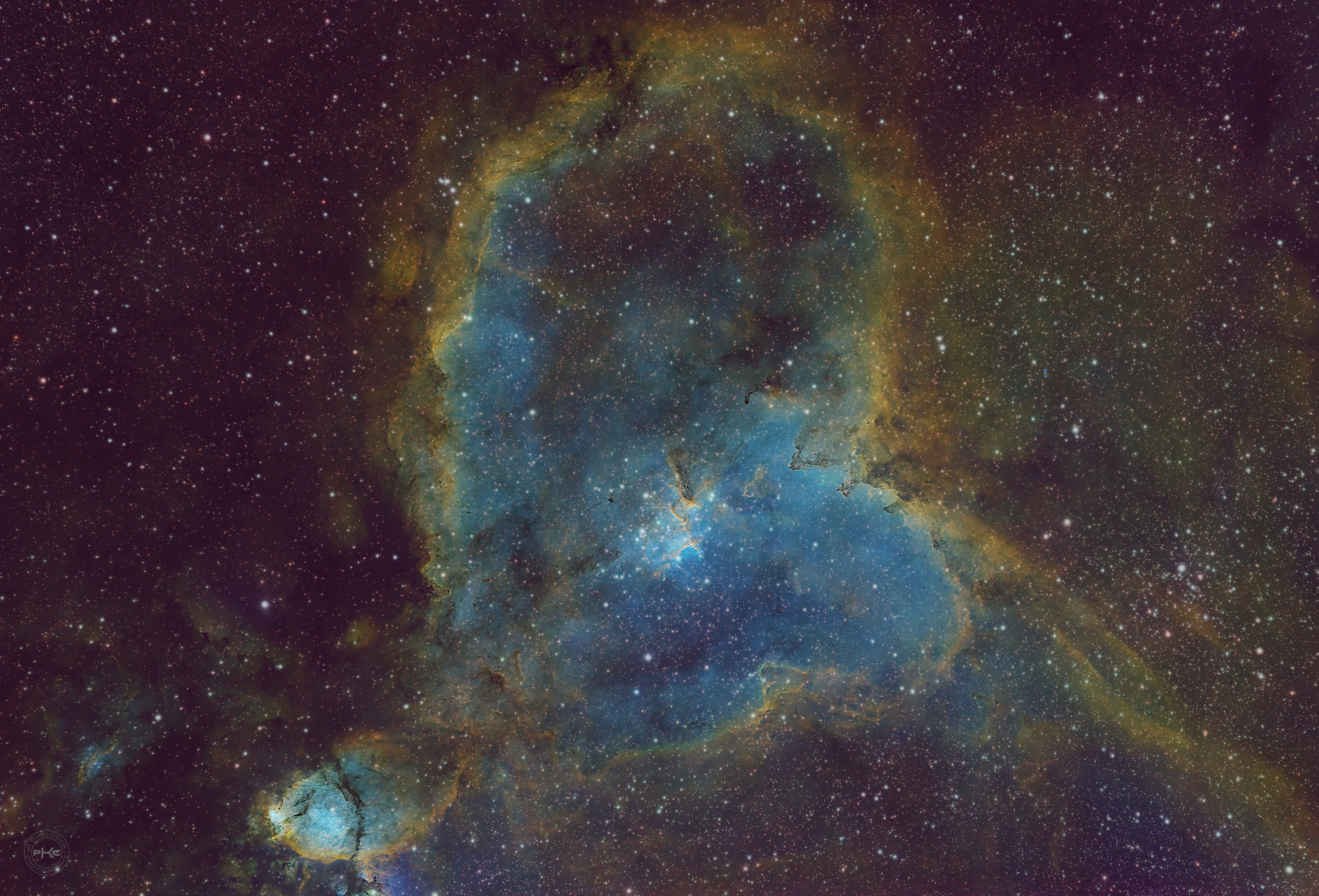
Heart Nebula – IC 1805
IC 1805 is a faint Nebula in the constellation Cassiopeia. The nebula is ~1.5 million years old and lies ~7500 light years from earth. The center of the nebula is a loose open star cluster, Melotte 15. This star cluster is responsible for the Red color in the nebula.
William Optics Zenithstar 73 with field flattener, ASI 2600 MC, Altair Quad Band filter, AM5. 30 x 300 secs (total integration 2.5 hrs).
Frame size (height x width) ~ 4 x 3 full moons
23-25 Sep 2025 Doylestown, PA
Processed in PixInsight
Copyright 2025 Paul C. Kolosick, All Rights Reserved

March
Veil Nebula (Great Cygnus Loop) NGC 6960, 6962-95
Remnants of a supernova explosion 5000-8000 years ago. The nebula is most strongly visible in the OIII wavelength. The nebula is about 100 light years across and is estimated to be 1400 to 2600 light years from Earth.
William Optics Zenithstar 73 with field flattener, ASI 2600MC Air, Optolong Ultimate filter, AM5 mount. Mosaic of two panels. Consisting of a total of 112, 300 sec frames (total integration 9.3 hrs).
Frame size (height x width) ~ 4 x 3 full moons
August 2025 Doylestown, PA
Processed in PixInsight
Copyright 2025 Paul C. Kolosick, All Rights Reserved

April
Pacman Nebula – NGC 281
NGC 281 is a large diffuse nebula in Cassiopeia. The crescent shaped nebula resembles the video game character it is named after. NGC 281 is ~10,000 light years from Earth and lies in the Perseus arm of the Milky way. There is a multiple star (HD 5005) at the center that ionizes the nebula’s gas.
William Optics Zenithstar 73 with field flattener, ASI 2600MC Air, Altair Quad band filter, AM5 mount. 30 x 300 sec frames (total integration 2.5 hrs).
Frame size (height x width) ~ 4 x 3 full moons
September 22, 2025 Doylestown, PA
Processed in PixInsight
Copyright 2025 Paul C. Kolosick, All Rights Reserved

May
Bode’s Nebula: M81 and M82
M81 (NGC 3031) also known as Bode’s Galaxy (near frame center) is a spiral Galaxy seen face on at ~ 12 million light years with a diameter of ~70,000 light years.
M82 (NGC 3034) also called the Cigar Galaxy (left side of frame) has been significantly disturbed by a relatively recent encounter with M81, displaying dust lanes and heavy star formation (red areas). M82 is a starburst galaxy ~ 12 million light years away.
Also in frame are NGC 2976 (upper right of frame) and NGC 3077 (lower center of frame) two spiral galaxies also ~12 million light years away and part of the same galactic group as M81 and M82.
William Optics Zenithstar 73 with field flattener, ASI 2600MC Air, Altair Quad band filter, AM5 mount. 270 x 300 sec frames (total integration 22.5 hrs).
Frame size (height x width) ~ 4 x 3 full moons
April 2025 Doylestown, PA
Processed in PixInsight
Copyright 2025 Paul C. Kolosick, All Rights Reserved

June
Rosette Nebula – NGC 2237 (includes the central star cluster NGC 2244)
The Rosette Nebula is a large circular emission Nebula. It covers a region of the sky about 5 times the size of the full moon. It is about 5,200 light years away with a diameter of ~130 light years.
The central “hole” is ~30 light years across. The central star cluster was formed from the nebula’s gas, and now illuminate the remaining gas. The region is still generating new stars.
William Optics Zenithstar 73 with field flattener, ASI 2600MC Air, Altair Quad band filter, AM5 mount. 40 x 300 sec frames (Total integration 3.3 hrs).
Frame size (height x width) ~ 4 x 3 full moons
March 2025 Doylestown, PA
Processed in PixInsight
Copyright 2025 Paul C. Kolosick, All Rights Reserved

July
Fireworks Galaxy NGC 6946
NGC 6946 is a nearby faint spiral galaxy. The galaxy is ~40,000 light years across and ~10 million light years from Earth. The Fireworks galaxy has significant regions of star generation (red highlight in Ha). Nine supernovas have been identified in NGC 6946, but it is unknown why this galaxy has so much activity.
Celestron 8″ Newtonian with coma corrector ASI 533MCr, Altair Quad band Altair 4nm HaO filter, NYX 101
69 x 180 sec Ha data, 185 x 180 sec RGB data (total integration time: 12.7 hrs)
Frame size (height x width) ~ 0.75 x 1 full moons
October 2025 Doylestown, PA
Processed in PixInsight, RGB plus Ha using DBExtract.
Copyright 2025 Paul C. Kolosick, All Rights Reserved

August
Milky Way
Milky Way galaxy over cabin and pine trees.
Nikon Z6ii, f/4, ISO 6400 with 28mm Nikon zoom lens. Ioptron Sky Tracker Pro.
30 x 20 sec frames (total integration time: 9 mins)
Frame size (height x width) ~ 80 x 65 full moons
August 2025 Usk, WA
Processed in PixInsight.
Copyright 2025 Paul C. Kolosick, All Rights Reserved

September
Pelican Nebula – IC 5070 (Hubble Palette)
IC 5070 is a large emission nebula in Cygnus, the Swan. The nebula is near the “east coast” of the North American Nebula, NGC 7000 (visible in the left side of the frame). The eye and bill are defined by dark dust clouds.
IC 5070 is ~2000 light years away and ~30 light years in diameter.
William Optics Zenithstar 73 with field flattener, ASI 2600MC Air, Altair Quad band filter, 4nm Ha OIII dual band, and 4nm OII SII dual band filters, AM5 mount. (total integration 22.5 hrs).
38 x 300 sec Altair dual band 4 nm Ha OIII filter
38 x 300 sec Altair dual band 4 nm OIII SII filter
25 x 300 sec Altair Quad band filter frames
RGB Stars from Quad band data
SII, Ha, and OIII extracted data (DBExtract) used for Hubble palette (SHO)
Frame size (height x width) ~ 4 x 3 full moons
September 2025 Doylestown and Cherry Springs, PA
Processed in PixInsight with DBExtract for narrowband.
Copyright 2025 Paul C. Kolosick, All Rights Reserved

October
Hercules Cluster or the Great Hercules Cluster M 13
M13 is considered the most spectacular globular cluster in the Northern hemisphere. It is fairly near to Earth at only 25,100 light years and has a diameter of ~145 light years. It consists of several hundred thousand stars. Near the center the stars are about 500 times more concentrated than in the solar neighborhood. At an age of ~12 billion years, it contains mainly old red stars.
32x10sec Nikon D7500 ISO 1600 on a Celestron N8 with coma corrector, Nikon D7500, ISO 1600, AVX. 32 10 sec frames (total integration: 5.3 min)
Frame size (height x width) ~ 1.5 x 1.3 full moons
June 2025 Doylestown, PA
Processed in PixInsight.
Copyright 2025 Paul C. Kolosick, All Rights Reserved

November
North America Nebula – NGC 7000
NGC 7000 is an emission nebula in Cygnus. The distance to the nebula is unknown. The nebula is primarily ionized Hydrogen and Oxygen. The nebula is on the edge of the Milky Way in the sky. The northern part of the nebula fades into the dense star field of the Milky Way.
William Optics Zenithstar 73 with field flattener, ASI 2600MC Air, Optolong Ultimate (HaO) filter, AM5 mount.
Mosaic of 4 panels 70 x 300sec exposures. RGB image from Dual band HAO data. (Total integration 5.8 hrs).
Frame size (height x width) ~ 4 x 3 full moons
September 2025 Doylestown, PA
Processed in PixInsight.
Copyright 2025 Paul C. Kolosick, All Rights Reserved

December
Triangulum Galaxy M 33 (NGC 598)
M33 is the 3rd largest galaxy in our Local Group (after Andromeda and the Milky Way). M33 is ~3 million light years from Earth and ~ 60,000 light years in diameter. The Triangulum Galaxy is ~750,000 light years from M31.
M33 is home to one of the largest known Ha regions. This region (NGC 604, red region at top-left of spiral) has a diameter of ~1500 light years. It contains at least 200 new hot stars with masses from 15 – 60 solar masses.
Celestron N8 with coma corrector, ASI533MC, Altair Quad Band and Altair 4nm Dual Band HaO filters, NYX101 mount.
75 x 180 secs with HaO Filter, 140 x 180 secs with Altair Quad Band filter
(total integration 10.75 hours). RGB from Quad Band plus Ha enhancement from HaO data using DBExtract
Frame size (height x width) ~ 1.3 x 1 full moons
October 2025 Doylestown, PA
Processed in PixInsight with DBExtract.
Copyright 2025 Paul C. Kolosick, All Rights Reserved