
Last week I had the opportunity to talk to a group of 5th grade students about the night sky. It was really energizing to see the interest these kids had in the topic. They asked a lot of questions, including one that I get asked almost every time I post or show a picture to friends and family. “How big is that?”
Honestly I love this question because it is a great launching point to so many ideas associated with astronomy and astrophotography (and a lot of other topics as well). As an astrophotographer, I think about what size object will fit on my camera sensor, just as a regular photographer thinks about what will fit in the frame of their camera. Just as with “regular” photography this is a function of the sensor size and the lens that is used, or for me the camera and telescope combination. Since I have several combinations possible, it is helpful to have a size scale that I can use to compare to the Field of View (FOV) of my camera/scope set-ups.
For astrophotography the normal size scale used is the angular size; measured in degrees, arcminutes, and arcseconds. This scale measures how many degrees (or more often fractions of a degree) of the sky the object covers. This scale measures the apparent size of the object, that is the size it appears to a viewer on Earth. From the horizon to the zenith (directly overhead) is 90°. For perspective on this scale the full moon is ~0.5° and we can hypothetically stack 180 full moons from the horizon to the zenith.
Many objects in the sky are much smaller than the moon so we also use fractions of degrees measured in arcminutes (symbol ′) and arcseconds (symbol ″). One degree (1°) is made up of 60 arcminutes (60′) and an arcminute is made up of 60 arcseconds (60″). A human with 20-20 vision can resolve objects down to ~1′. (As a side note, we can thank the ancient Sumerians and Babylonian astronomers for these units.)
The angular size scale used for apparent size of objects takes into account the fact that objects at large distances appear small compared to objects that are closer to the observer. Most people are familiar with the fact that the sun and moon appear to be the same size to a viewer on Earth, while knowing that the sun is much bigger than the moon. The similarity in apparent size of the sun and moon is why we get such interesting solar eclipses on Earth.
The table below has the apparent and actual size of several astro targets. You can see that size and distance lead to apparent sizes that make sense. Below the table are a few specific pictures I have taken that show some of the objects in the table. (A final note, the solar system objects below are shown in kilometers (km) while the extra solar objects are shown in light years (ly). A ly is equal to ~9.5 trillion km).
Next time I’ll talk about the telescopes and camera sizes used for these pictures and how their characteristics help me match targets to telescopes and cameras.
Till next time, clear skies,
Paul

Whirlpool Galaxy (M 51)

M51 is ~28 million light years (ly) away and is approximately 91,000 ly across. The smaller M51a/NGC5194 has interacted with the larger M51 as can be seen by the trailing spiral arm of M51. There are two distant galaxies visible to the right (IC 4263 and NGC 5169)
Williams Optical Zenithstar 73 with Field flattener, ASI 2600MC, Altair Quadband filter, AM5 120 x 300 sec (total integration time 10 hrs)
Doylestown, PA
Mar 2025
Copyright 2024 Paul C. Kolosick
All Rights Reserved
Jupiter

Shadow transit of Ganymede on Jupiter with Europa and Io.
Both the shadow of Ganymede and Ganymede itself are visible on the lower left edge of Jupiter.
Celestron 8″ Newtonian, Celestron 2xBarlow, ASI183MC, AVX
Lucky seeing technique
Copyright 2022 Paul C. Kolosick
All Rights Reserved
Pleiades Star Cluster (M 45)

Williams Optical Zenithstar 73 with field flattener, ASI 2600MC, Alstair Quadband filter, 29 x 300 sec (total integration ~2.5 hours)
Oct 2024, Doylestown, PA
Copyright 2024 Paul C. Kolosick
All Rights Reserved
The Moon and Sun (Total Solar Eclipse)

Nikon D7500 with Sigma 100-400mm Zoom Lens @ 400mm (35mm equivalent 600 mm). Tracking with Star Adventurer GTi. No filter during totality.
Apr 2024 Goldthwaite, TX
Processed in Photoshop
Copyright 2024 Paul C. Kolosick
All Rights Reserved
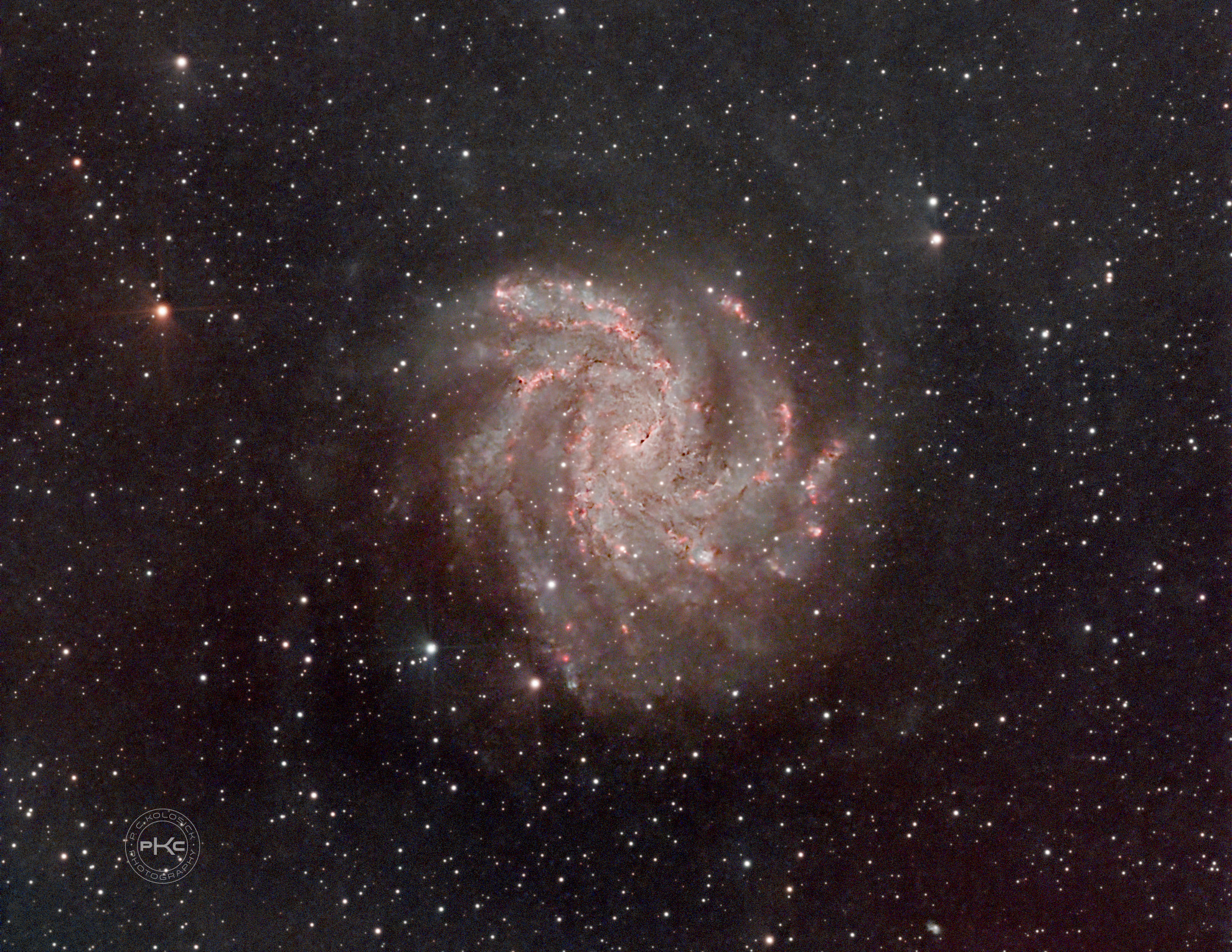
Fireworks Galaxy (NGC 6946)

NGC 6946 is a nearby faint spiral galaxy. The galaxy is ~65,000 light years (ly) across and ~19 million ly from Earth. The Fireworks galaxy has significant regions of star generation (red highlight in Ha). Nine supernovas have been identified in NGC 6946, but it is unknown why this galaxy has so much activity.
Celestron 8″ Newtonian with coma corrector, ASI 533MC, Altair Quad band and Altair 4nm Ha filters, NYX 101, 69 x 180 sec Ha, 185 x 180 sec RGB (total integration time: ~13 hours
Doylestown, Pa
Oct 2025
Processed in PixInsight
Copyright 2025 Paul C. Kolosick
All Rights Reserved
Leave a Reply